
Pertanyaan :
- Draw a simple diagram of a neuron and label its components (inputs, weights, bias, activation function).
- What is the purpose of an activation function (like Sigmoid or ReLU)?
- What is the purpose of an activation function (like Sigmoid or ReLU)?
- What is the difference between an input layer, a hidden layer, and an output layer?
Jawaban :
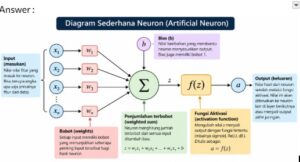
2.
An activation function processes a neuron’s calculated value and allows a neural network to learn complex or nonlinear patterns.
For example:
- Sigmoid: converts values into a range between 0 and 1, making it useful for binary classification.
- ReLU: converts negative values to 0 while keeping positive values unchanged.
Without nonlinear activation functions, a neural network with multiple linear layers can be simplified into a single linear transformation.
3.
Backpropagation calculates how the weights and biases in a neural network contribute to prediction errors. This information is used by an optimization algorithm to update the parameters and improve predictions.
In simple terms:
- The model makes a prediction.
- The prediction is compared with the correct answer.
- The error is calculated.
- Backpropagation calculates the gradients of the error with respect to the model parameters.
- An optimizer uses these gradients to update the weights and biases.
4.
Answer :
Layer type →Function
Input layer →Receives input data, such as numbers, text, or image features.
Hidden layer →Processes data and learns patterns using neurons, weights, biases, and activation functions.
Output layer →Produces the final result, such as a numerical prediction or a category.
For example, in a cat image recognition system, the input layer receives image data, the hidden layers learn features such as ear and face shapes, and the output layer predicts whether the image contains a cat.
status : selesai 100%