
Module Question 6
- Draw a simple diagram of a neuron and label its components (inputs, weights, bias, activation function).
- What is the purpose of an activation function (like Sigmoid or ReLU)?
- What is the purpose of an activation function (like Sigmoid or ReLU)?
- What is the difference between an input layer, a hidden layer, and an output layer?
Answer:
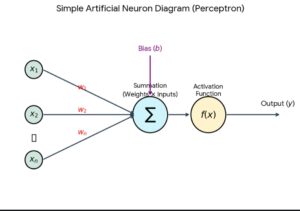 An artificial neuron receives inputs, multiplies each input by its weight, adds a bias, and applies an activation function to produce an output.
- The purpose of an activation function is to introduce non-linearity into a neural network, allowing it to learn complex patterns. Sigmoid produces values between 0 and 1, while ReLU returns zero for negative inputs and the input itself for positive values.
- The purpose of an activation function is to introduce non-linearity into a neural network, allowing it to learn complex patterns. Sigmoid produces values between 0 and 1, while ReLU returns zero for negative inputs and the input itself for positive values.
- Input layer: Receives the raw data or features.
Hidden layer: Processes the input data and learns patterns using weights, biases, and activation functions.
Output layer: Produces the final prediction or result, such as a classification or numerical value.