
Artificial Intelligence 26/27 – BD107
Module Question 6
1. Draw a simple diagram of a neuron and label its components (inputs, weights, bias, activation function).
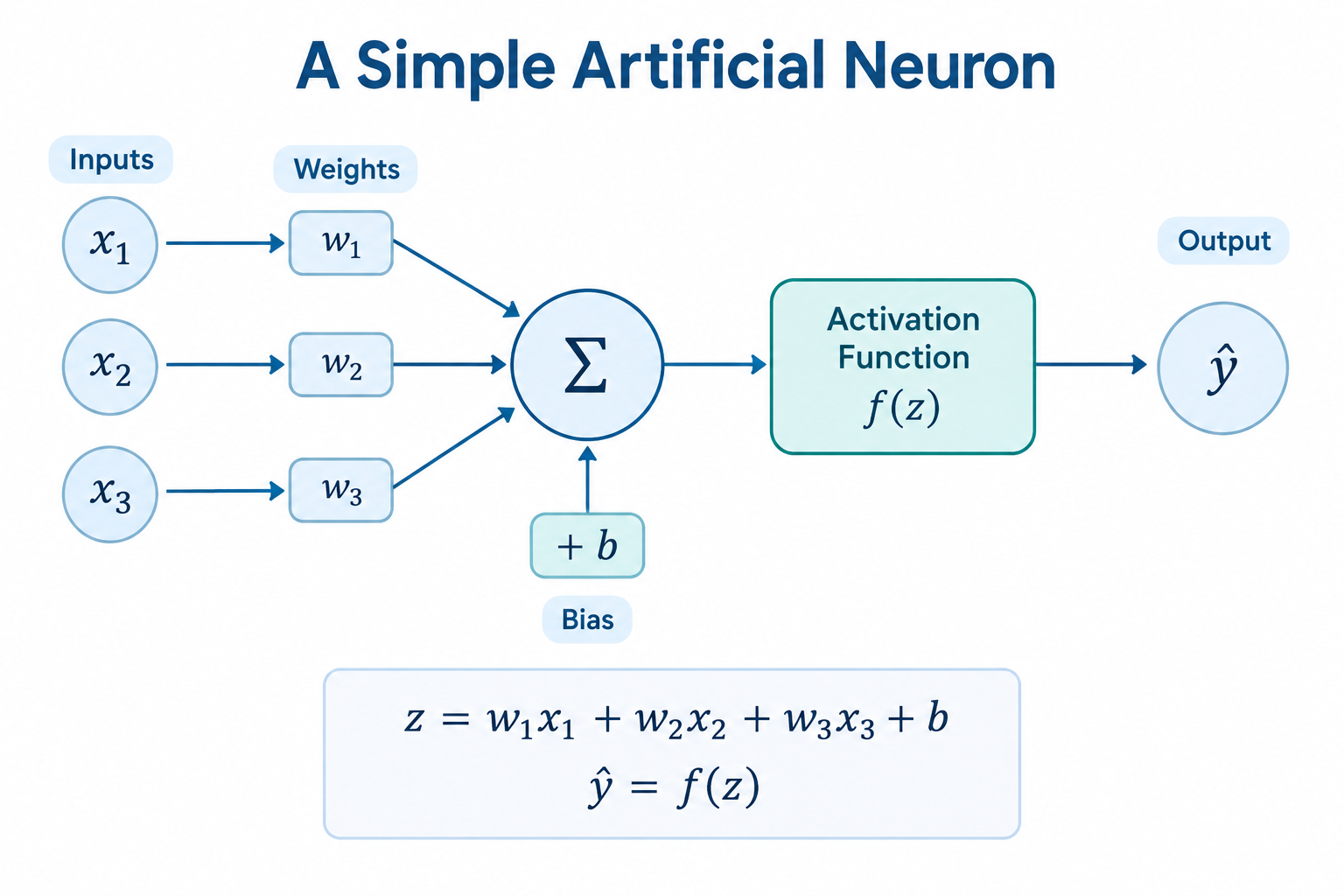
Figure 1. A simple artificial neuron showing the inputs, weights, bias, summation process, activation function, and output.
2. What is the purpose of an activation function (like Sigmoid or ReLU)?
The purpose of an activation function in a neural network is to introduce non-linearity into the model, allowing it to learn complex patterns and relationships in data. Without activation functions, a neural network would behave like a linear model, even if it had multiple layers, which would limit its ability to solve complex problems.
Two common activation functions are Sigmoid and ReLU. The Sigmoid function converts values into a range between 0 and 1, making it useful for producing probability-like outputs in certain classification tasks. ReLU (Rectified Linear Unit) outputs zero for negative inputs and keeps positive inputs unchanged. It is widely used in hidden layers because it is simple and helps neural networks learn complex patterns.
3. In simple terms, what does the process of “backpropagation” achieve?
Backpropagation is a process used to train a neural network by identifying how much each weight contributes to the error in its predictions. It works by sending information about the error backward from the output layer through the network to help determine how the weights should be adjusted.
During training, the model compares its prediction with the correct answer and calculates the error. Backpropagation then calculates how the weights affect that error, while an optimization algorithm, such as gradient descent, uses this information to update the weights and reduce the error. This process is repeated until the model produces more accurate predictions.
For example, if a neural network predicts the wrong product category, backpropagation helps the model determine how its weights contributed to the incorrect prediction so they can be adjusted during training.
4. What is the difference between an input layer, a hidden layer, and an output layer?
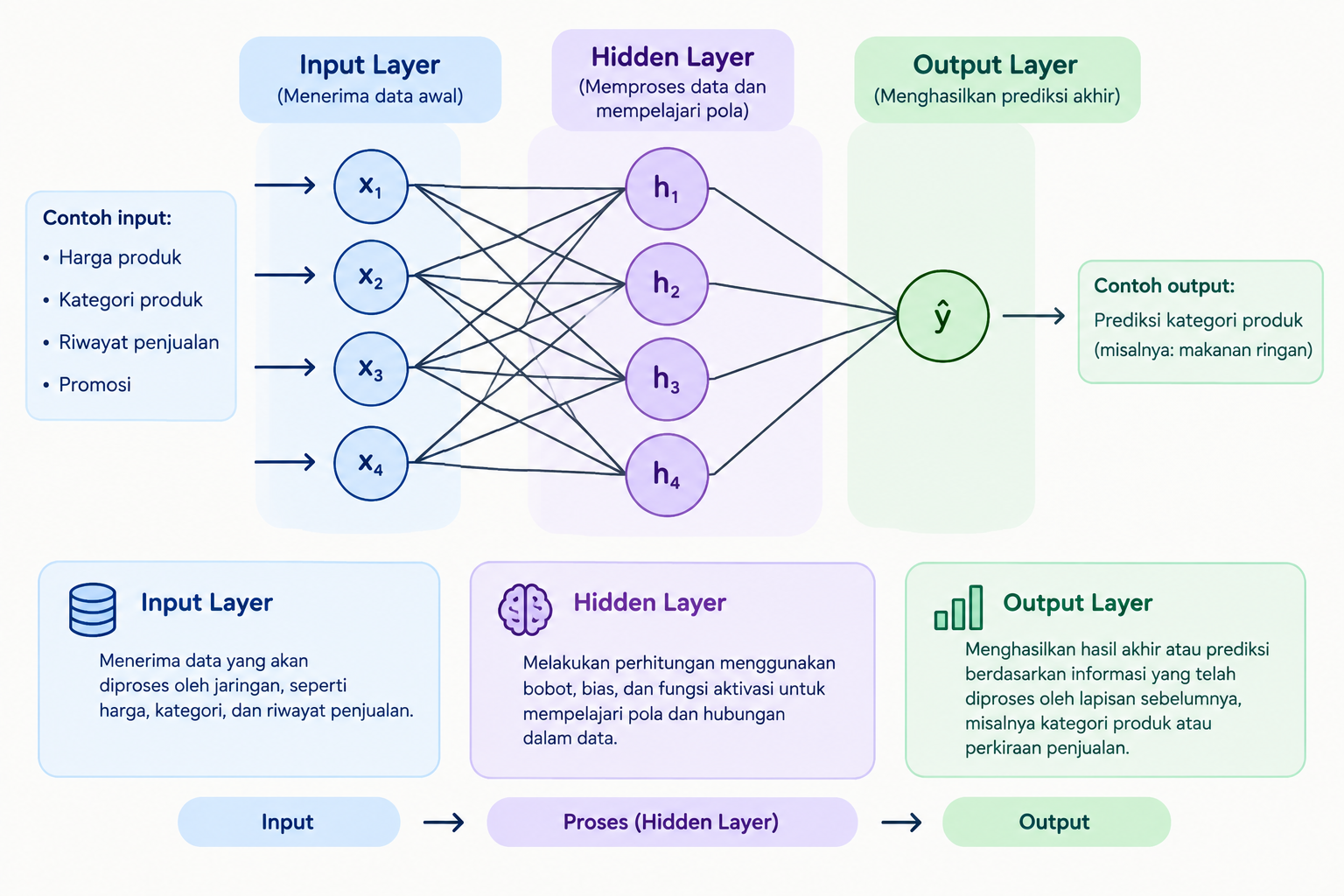
The input layer, hidden layer, and output layer are the three main types of layers in a neural network, and each has a different function.
The input layer receives the initial data that will be processed by the network. For example, it may receive information such as a product’s price, category, and sales history.
The hidden layer processes the input data by performing calculations using weights, biases, and activation functions. A neural network can have one or more hidden layers, which help the model learn patterns and relationships in the data.
The output layer produces the final result or prediction based on the information processed by the previous layers. For example, it may predict a product category or estimate future sales.
In conclusion, the input layer receives data, the hidden layer processes it and learns patterns, and the output layer provides the final prediction.
Status: 100%
- Keterangan: sudah mengerjakan tugas sesuai instruksi.